Student Challenge 2026 Success
One of the highlights of this year’s tNavigator Summits has been seeing the enthusiasm and emerging talent showcased through our Student Challenges.
In London, we invited four finalists to present their ideas live to the Summit audience before voting took place to decide the winner. The applicants were tasked to prepare a presentation that explored an innovative solution to address challenges across the energy industry using tNavigator. It was fantastic to see the confidence, technical knowledge, and fresh perspectives each student brought to the stage.
For our Perth and Brisbane Summits, we took a slightly different approach, with students submitting a three-minute video presenting an answer to a big question: what needs to be done to ensure a bright future for the energy industry? After reviewing some excellent entries, we selected the winner ahead of the event and invited them to the Summit for a Q&A session, giving attendees the opportunity to hear more about their work and their journey.
Aida Kanatbayeva participated in last years’ final, and now works with us as a Reservoir Engineer. We asked Aida for her thoughts and reflection, after experiencing the Student Challenge from both sides:
The Student Challenge was so much more than just a competition. It gave me the chance to learn, collaborate, and take on real-world challenges. Looking back, it was an incredibly rewarding experience that helped me grow both personally and professionally. Having experienced the Student Challenge from both sides, I’ve come to appreciate just how much talent and enthusiasm it brings together. Reading this year’s applications reminded me that it’s not just about finding the best idea. It’s about giving students a chance to challenge themselves and grow.
It’s incredibly rewarding to see so many aspiring engineers and geoscientists engaging with real industry challenges and demonstrating such a high standard of innovation. A huge thank you to everyone who participated, our team who took the time to review the submissions, and everyone who helped make these challenges such a success. We look forward to continuing the initiative in years to come!
If you want to find out how tNavigator can support your University with our free educational licenses, get in touch with us.
Let us introduce you to to our winners!
London
Dmitry Trushin, University of Aberdeen: A Generalised Framework for Enhanced Condensate Recovery Evaluation: Integrating Numerical Modelling, Machine Learning and Economic Assessment
Dmitry is a recent MSc Petroleum Engineering graduate with Distinction from the University of Aberdeen, where he currently works as a Teaching and Research Assistant. His research focuses on intelligent frameworks for enhanced condensate recovery evaluation, bridging the gap between high-fidelity reservoir simulation and practical machine learning surrogate models.
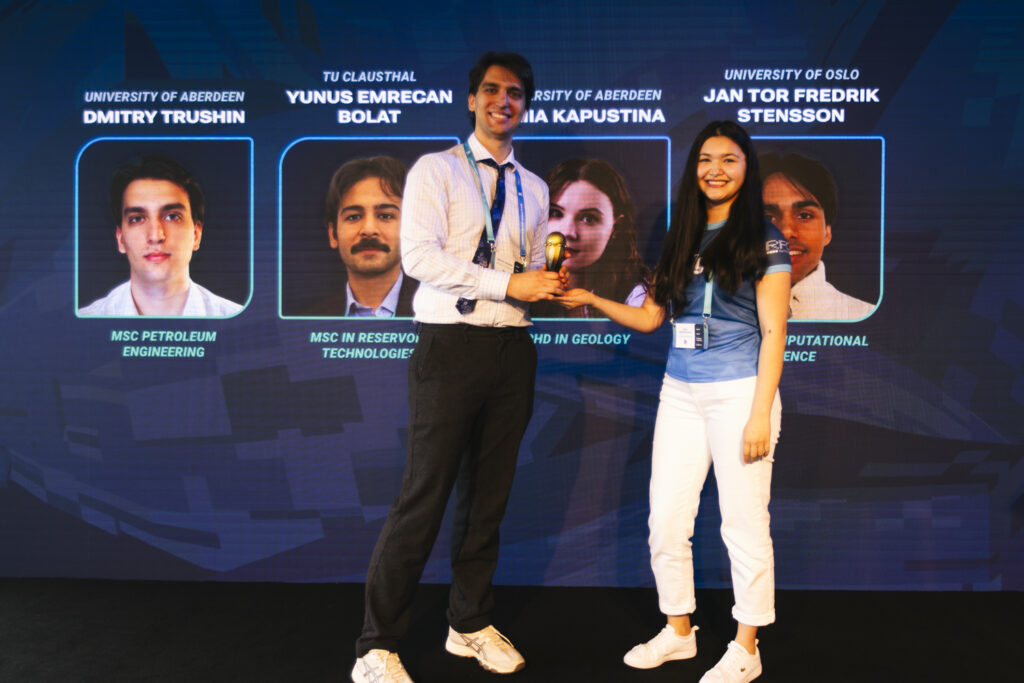
Dmitry reflected on his experience in the Student Challenge:
I am very grateful for the opportunity to present my work to the audience of professionals and feel very proud to have my project appreciated by them. I believe that young professionals can bring a lot of innovation to our industry, and this Summit is an extremely important and unique event that bridges new graduates with experienced industry professionals.
Congratulations, Dmitry!
Perth
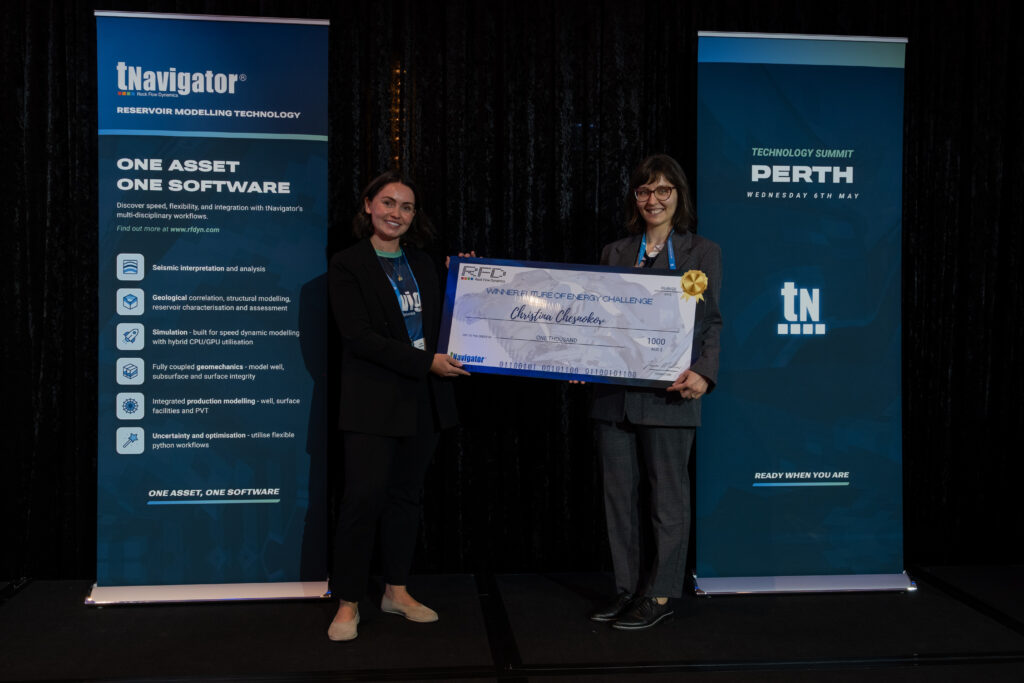
Christina Chesnokov, Adelaide University: https://www.youtube.com/watch?v=adi3qewE7dc
Christina Chesnokov is a fourth-year PhD candidate in Petroleum Engineering at Adelaide University, where her research focuses on well injectivity and fluid behaviour during CO₂ storage in depleted formations, co-funded by Shell Global Solutions. Her work combines analytical modelling with laboratory-scale core flooding experiments, including a guest research placement at TU Delft last year working directly with Shell on industry-relevant CCS challenges. She is a recipient of the SPE-SA Scholarship and the 2026 CO2CRC Best Presentation Award and is passionate about the role of subsurface engineering in the energy transition.
Brisbane
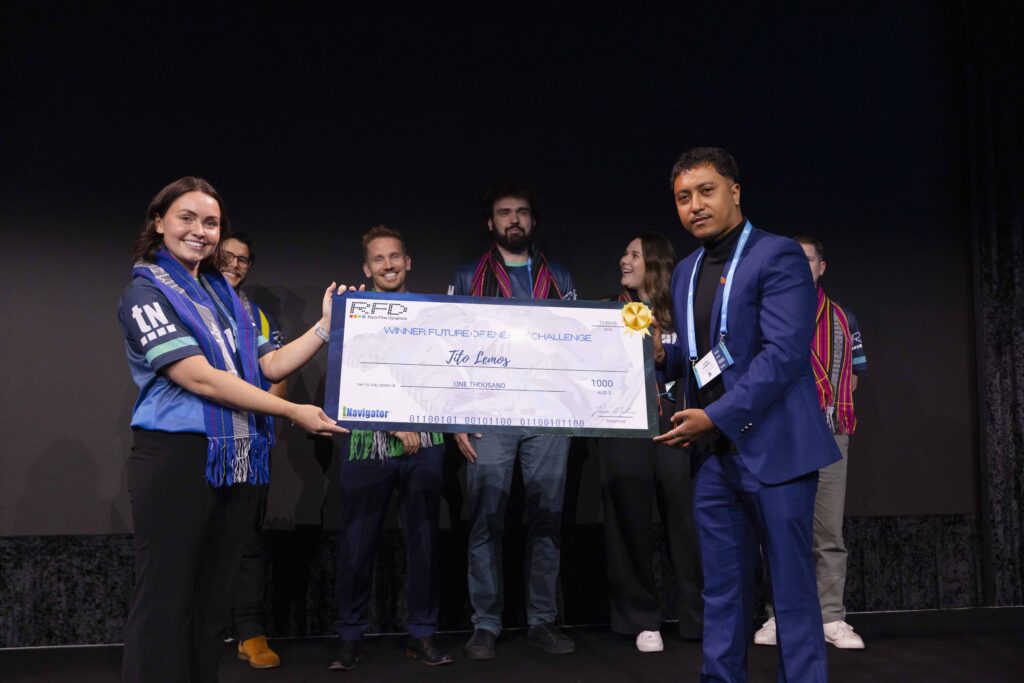
Tito Lemos, Dili Institute of Technology:https://www.youtube.com/shorts/dovTIH7f8aE
Tito Cesario Fernandes Lemos is a final year Petroleum Engineering student at Dili Institute of Technology, specialising in Drilling Engineering. He recently completed a professional internship at PPSDM Migas Cepu in Indonesia, where he gained valuable hands-on experience in petroleum sector operations. As the winner of the Australia Future Energy Challenge 2026, Tito is passionate about advancing technological solutions and contributing to the sustainable future of the energy industry.
Lets meet our other London finalists!
Fredrik Stensson, University of Oslo: Operational and Formation Uncertainty Effects on CO2 Storage Metrics: a Sleipner Inspired Study
Fredrik holds a bachelor’s degree in mathematics and computer science and is currently pursuing a master’s degree in computational science, both at the University of Oslo. For his thesis, he investigates the effects of geological uncertainty and varying operational parameters on CO2 storage performance. His work combines his background in statistical modelling with his current research interests in computational modelling and subsurface CO2 storage.
Iuliia Kapustina, University of Aberdeen: A Statistical Approach for Building Comparable Reservoir Models from Virtual Outcrops: Flow Simulation Results for Carbon Capture and Storage
Iuliia is a PhD researcher at the University of Aberdeen and a member of the SAFARI research group. She holds a Master’s degree in Integrated Petroleum Geosciences and has a solid background in geophysics and geology supported by industry experience. She specialises in reservoir modelling based on virtual outcrop studies, and her research investigates how geological heterogeneity within different depositional environments influences fluid flow behaviour, with applications to hydrocarbon reservoirs and CO₂ storage sites.
Yunus Emrecan Bolat, TU Clausthal: Feasibility of CO₂-Based Geothermal Systems for District Heating in Shallow Reservoir
Yunus is currently pursuing his Master’s degree in Reservoir Technologies at TU Clausthal, Germany. For over a year, he has been working as a university assistant, supporting reservoir simulation workshop classes. His current focus is on numerical reservoir simulations and their applications in sustainable energy systems.